

UK Apprenticeship Participation Is Falling: Even as Pay Rises
Updated: Mar 4
16 February 2026 | By Ben Falconer
I’m a big believer in apprenticeships, they are one of the UK’s best ladders for upward mobility and in a country where moving up feels less common than it used to, that matters more than ever.
The benefits are obvious: earn while you learn, avoid a mountain of debt, and build real career momentum - while graduates pay tens of thousands to qualify, then still need months of on-the-job training before they’re productive.
I grew up in Dundee, Scotland - a place where opportunities can feel limited. Dundee’s unemployment has sat around 6.4% (vs 3.8% across Scotland) for many years.
Dundee’s the kind of place that can make headlines for all the wrong reasons: "Dundee - Europe's drug death capital", or "Dundee now britains teen pregnancy capital of Britain".
However, traditionally Dundee was famous for the three Js (Jute, Jam and Journalism), although these trades were most active in the Mid-1800s to early 1900s and Dundees employment rate has plummeted in more modern years.
I was fortunate enough to land a Modern Apprenticeship in Mechanical Engineering with Jacobs in my late teens. That opportunity genuinely changed the direction of my life - I don’t believe I’d be where I am today without it.
That’s exactly why this matters. When apprenticeships work, they don’t just fill vacancies - they change lives, strengthen communities, and give people a fair shot at building a career without needing a traditional university route.
Apprenticeships have long been positioned as a practical route into skilled work - especially in construction, where employers repeatedly flag shortages across multiple trades and professional disciplines. Yet the data suggests an uncomfortable tension: participation and completions are both lower than they were in 2016/17, even as the minimum apprentice wage has risen sharply in both nominal and inflation-adjusted terms.
UK Apprenticeship Participation
Figure 1 shows a stark image for the UK - How many people were actively on an apprenticeship (“in learning”) each year - peaking at 909,000 in 2016/17 and sitting at 761,500 in 2024/25, a 16.7% drop overall.
One big shift in the background was the Apprenticeship Levy (brought in 2017). In theory, it was a positive move - it created a ring-fenced pot of money for training and pushed more employers to invest in skills. But it also came with extra admin and compliance: choosing approved training providers, setting up and managing accounts, signing training plans, logging progress reviews, keeping evidence for audits, and juggling paperwork across the employer, provider and apprentice. This may have lead to a decrease in employer intake of apprentices over time.

UK Apprenticeship Completions
Figure 2 is the part that should worry us most. It shows how many apprentices actually finish each year - and that number has fallen from 278,000 in 2016/17 to 198,000 in 2024/25, a 28.8% drop overall.
And here’s the kicker: completions have dropped faster than participation. So it’s not just “fewer people starting” - it also points to more people not making it to the finish line or taking longer to complete their apprenticeship.

UK Apprentice Nominal Rates (increase over time)
Figure 3 shows the one thing that’s moved in the right direction: pay. The apprentice minimum wage has climbed from £3.30/hour in 2016/17 to £6.40/hour in 2024/25 - a 93.9% nominal increase.
On paper, that increase looks huge. But “nominal” is the key word here: it’s the headline rate before you account for inflation.

UK Apprentice Inflation Adjusted Rates (Increase over time)
Figure 4 is the “real world” version of Figure 3. Once you adjust for inflation, apprentice pay still rises — from £4.59/hour (in today’s money) in 2016/17 to £6.77/hour in 2024/25. That’s a 47.5% increase in real terms.
So yes - apprentices are genuinely better off than they were in 2016/17, even after the cost of living is factored in.
Which makes the bigger question even more frustrating: if pay is improving, why are participation and completion rates still down?
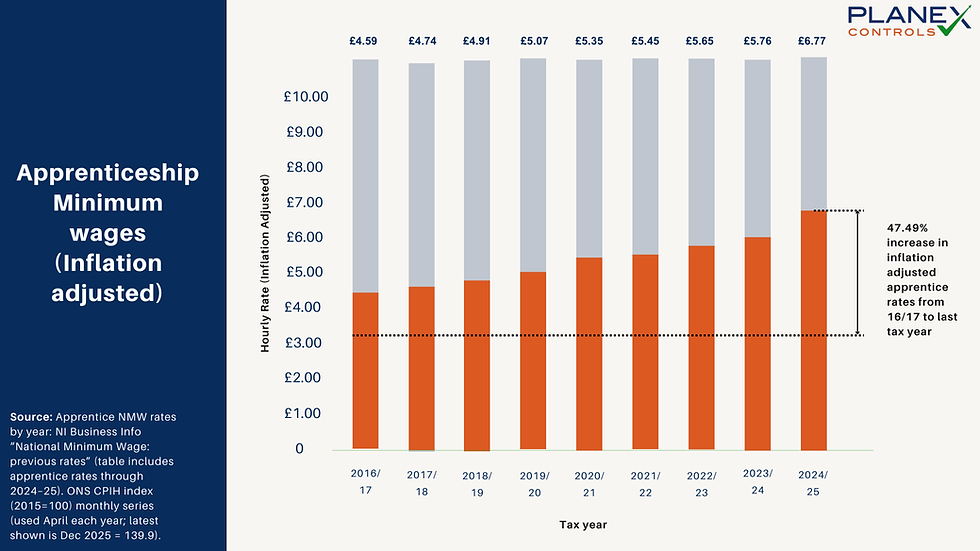
Figure 4. Apprentice minimum wage (inflation-adjusted), 2016/17–2024/25.
Does the bigger drop in completions mean more people are dropping out?
Completions are down 28.8% since 2016/17 - a much bigger fall than participation.
Does that mean more apprentices are dropping out?
Maybe… but don't come to a conclusion just from that headline.
Apprenticeships today are often longer: 6-7 year Higher-Level degree apprenticeships are becoming more common and this could be leading to the increased downfall in completion rates in recent years.
Employer sponsored degrees aren’t new - but putting more training under the apprenticeship umbrella can allow employers to justify longer periods of lower wages.
Perhaps a better option would be to have a more accelerated route to Level 4 (HNC level) education, reducing timelines between career progression milestones and therefore increasing apprentice satisfaction.
Level 5 (HND level) and above training can be done under a continued professional development banner and hopefully allow the apprentices to do productive work from the end of year 4 (at very latest) and earn more livable wages: allowing them to move out of their parents houses and start a life of their own earlier.
Why might participation and completions be down even though pay is up?
The charts are consistent with several overlapping explanations (none of which require a single ‘young people don’t want to work’ narrative):
Cost of living & practical barriers: Even with a higher minimum rate, apprentices can face travel costs, tools, PPE, and unstable transport/shift patterns - and many roles are in high-cost areas. If the real disposable income still feels tight, retention suffers.
Employer capacity & supervision: An apprenticeship requires structured training, supervision, and off-the-job learning time. When projects are busy or margins are tight, some employers struggle to resource high-quality support.
Training delivery and admin friction: Employers (especially SMEs) often cite complexity: finding providers, navigating rules, and managing paperwork. Friction reduces starts and can disrupt learners mid-programme.
COVID-era disruption and after-effects: Lockdowns and site restrictions disrupted training and assessment. Some cohorts may have deferred, paused, or exited - with knock-on effects on completions in later years.
Competition from other routes: For some candidates, direct employment, short courses, bootcamps, or alternative sectors may look more attractive - especially if they offer earlier pay progression or more predictable schedule
What this might suggest for construction
Taken together, the charts point to a system that may be improving pay at the entry point, but still leaking talent before completion. For construction, that can translate into:
A smaller pipeline of newly-qualified workers, even if headline participation looks relatively stable.
More pressure on experienced staff to cover skills gaps (and to mentor apprentices).
Higher recruitment costs and longer hiring cycles - especially when major programmes ramp up.
What can be done ?
Build pay progression into the apprenticeship: A clear pay ladder tied to milestones (e.g., 3/6/12 months, or competencies and accreditations received).
Reduce the ‘hidden costs’ for apprentices: Simple bursaries for travel, tools, and PPE.
Improve onboarding and role realism: A short ‘day-in-the-life’ preview, clear site expectations, and a named mentor.
Use completion as the key success metric: Track starts, but manage to completions: identify at-risk learners early (attendance, confidence, supervisor feedback) and intervene fast.
Make it easier for SMEs to participate: Where levy transfers or shared apprenticeships are possible, simplify access and provide template processes so SMEs aren’t overwhelmed.
Conclusion
The headline isn’t that apprenticeships are ‘failing’ - it’s that the system’s bottleneck looks increasingly like retention and completion.
Pay has improved meaningfully, but apprenticeships still need better support, clearer progression, and fewer practical barriers if we want higher completion rates and a stronger pipeline into construction.
Sources
UK Parliament, House of Commons Library -Apprenticeship participation and completions (DfE underlying data).
NI Business Info - National Minimum Wage previous rates (apprentice rate).
Office for National Statistics (ONS) CPIH index (2015=100) used for inflation adjustment.
What do you think would improve apprentice completion rates the most?
Modular Training (shorter periods of off Job training)
Better Mentoring & Structured Support
Higher first-year pay & travel allowance
Cut the paperwork & admin burden for organisations
About the author
Written by the team at Planex Controls. We publish opinion pieces and detailed investigative analysis on the construction and engineering industries - bringing to light practices that aren’t right, and breaking complex scenarios down into clear, plain English.
Alongside that, we share practical insight on project controls and project management: how to build robust planning and reporting, improve governance and decision-making, strengthen cost and schedule control, and put simple systems in place that help programmes stay on track.

Planex Controls is an expert provider of project management systems and professionals; supporting a range of major organisations across multiple sectors.
Looking for your next role? Register your CV with us:
Need a Project Management team quickly?: Speak to us about resourcing your project: https://planexcontrols.com/#client-enquiry


Comments